








































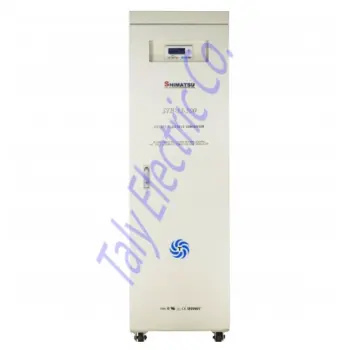
Operating mechanism of Shimatsu fully industrial three-phase stabilizers:
A stabilizer is a voltage regulation and stabilization system that rapidly detects and automatically corrects voltage drops, fluctuations, or any network interference. These devices operate silently and utilize state-of-the-art cylindrical servo technology.
This class of stabilizers performs voltage correction by varying the number of coil turns on cylindrical cores. Key features include linear continuity, a perfect sinusoidal waveform, and phase synchronization.
These units employ a digital control mechanism, offering high power capacity, efficiency, precision, and controlled output voltage quality.
In the STB series voltage stabilizers, each phase is equipped with a DC servo motor mounted on a variable transformer.
By adjusting the number of coil turns via the servo motor’s moving arm, the transformer’s induction—and consequently the output voltage—is increased or decreased. The primary winding of the buck/boost transformer is fed by the variable unit, while its secondary winding is connected in series between the output line and the power source, thereby adding or subtracting the voltage required by the network. An electronic control circuit continuously monitors the device’s output voltage and compares it against a fixed reference value (e.g., 220V). If the voltage deviates from the set level, a command is sent to the servo motor to move the carbon brush arm along the variable transformer (Variac) until the voltage returns to the permissible range; the motor and brush arm then remain stationary until the next voltage fluctuation triggers further movement.
This voltage correction method generates no harmonic interference and introduces no disturbances into the input power source. The rapid movement of the servo-driven carbon brush arm, combined with precise real-time voltage control, eliminates or significantly minimizes voltage overshoot.
The output voltage control system also compensates for voltage fluctuations caused by changes in load current.
The regulated voltage is continuously sampled by a high-speed analog amplifier and compared against a highly stable DC reference voltage; the magnitude of the voltage difference is then transmitted to the servo motor control system. The servo motor activates rapidly and reliably to compensate for the voltage, adjusting the position of the carbon brush arm until the desired level is reached.
Shimatsu column-type stabilizers feature advanced safety systems—including smoke and fire detection, phase monitoring, and over-voltage and over-current protection—and comply with international standards such as ISO 9001 and ISO 14001. Additional Specifications:
Negligible energy loss and 98% efficiency
Electrical circuitry featuring a feedback control system
Microprocessor-based control of each phase independently via three servo motors
Filter included to suppress noise and transient voltage spikes in the output
Automatic power cutoff system for short-circuit protection
Automatic power cutoff system for undervoltage and overvoltage protection
Automatic power cutoff system for loads exceeding 2.8 times the rated capacity
Silent operation, suitable for quiet environments
Phase failure protection system
Bypass switch for direct input-to-output connection during emergencies
Automatic power cutoff system for over-temperature protection
Overload warning alarm system
5 kVA insulation rating
Pure sine wave output voltage
Operating humidity range: 40%–90%
Very low no-load current (below 0.5 Amps)
Suitable for use in various environments (indoor and outdoor)
Displays input/output voltage (phase-to-phase and phase-to-neutral) and individual phase current
All-copper windings
Unaffected by power factor (cos φ)
Automatic cooling system
Compliant with Iranian standards
Reviews
Clear filtersThere are no reviews yet.